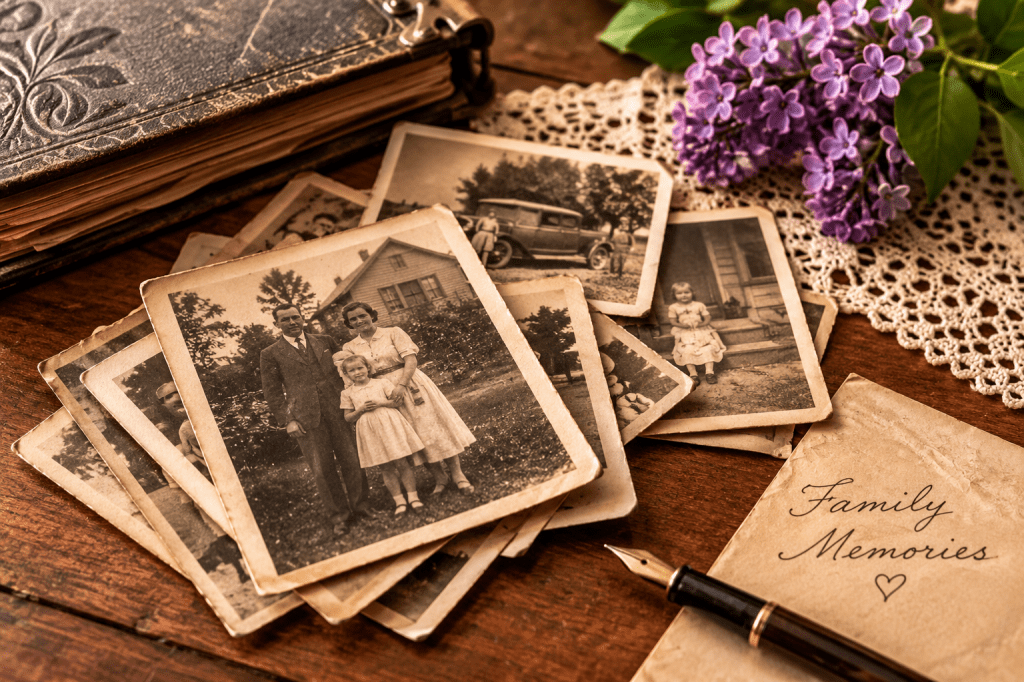
There is something almost magical about holding an old family photograph.
Maybe it is a faded wedding portrait tucked inside a box. A snapshot of your grandfather standing beside his first car. Your mother as a little girl on the front steps of a house that no longer exists. Or a photograph of several solemn-looking relatives whose names nobody seems to remember anymore.
Old photographs give us a glimpse into lives that came before ours.
But photographs are fragile.
They fade. They curl. They become brittle. They are damaged by moisture, sunlight, tape, old albums, basements, attics, and simply the passing of time.
And sometimes the photograph survives while something even more important disappears:
The story.
A perfectly preserved photograph of five unidentified people eventually becomes a picture of five strangers.
That is why preserving family photographs isn’t simply about protecting pieces of paper. It is about preserving the names, places, relationships, memories, and stories connected to them.
Here are some simple things you can do now to help make sure your family’s photographs—and the stories behind them—are still here for generations to come.
Start With the Photographs You Already Have
You don’t need to organize your entire family history in one weekend.
Start with one box.
One album.
One drawer.
Gather photographs that have been scattered around the house and take a quick look at what you have.
Don’t worry about putting everything into perfect chronological order yet. Your first goal is simply to discover what is there.
You may be surprised by what you find.
Old school pictures. Wedding photographs. Vacation snapshots. Photographs mailed inside letters. Pictures of houses, farms, pets, cars, military uniforms, birthday parties, and ordinary afternoons that nobody realized would someday become history.
Those everyday photographs can be some of the most precious.
Identify People While Someone Still Can
This may be the most important step of all.
If you have parents, grandparents, aunts, uncles, cousins, or older family friends who might recognize the people in your photographs, ask them now.
Sit together with a stack of pictures.
Don’t only ask:
“Who is this?”
Ask:
“Where was this taken?”
“Whose house was that?”
“What was happening that day?”
“Who took the picture?”
“What kind of car is that?”
“Why was everyone dressed up?”
“Did you know these people well?”
“What do you remember about them?”
One photograph can unlock a memory that leads to another memory—and suddenly you have a story you never knew existed.
Better yet, record the conversation on your phone if everyone is comfortable with it. Years from now, hearing that person’s voice telling the story may mean as much as the photograph itself.
Write Down More Than a Name
Imagine finding an old photograph labeled simply:
Grandma
That might make perfect sense today.
But which grandma?
To your grandchildren or great-grandchildren, it may be impossible to know.
Whenever possible, record a person’s full name, including a maiden name when known.
Instead of:
Grandma and Grandpa
write something more like:
Margaret Ellen Smith Livermore and William James Livermore, probably taken near Sioux City, Iowa, about 1900.
Even if you aren’t certain about a date or location, write what you know.
Words such as about, possibly, probably, and believed to be are perfectly acceptable. It is much better to preserve a good clue than to leave nothing at all.
Be Careful Writing on Original Photographs
It can be tempting to grab the nearest pen and start labeling.
Don’t.
Ink can bleed through photographs, and pressing hard with a ballpoint pen can leave permanent indentations.
Whenever possible, keep identifying information with the photograph using archival-safe materials or record the information separately and connect it to the photograph with a numbering system.
If you do write directly on the back of a modern photograph, use a photo-safe archival pencil or marker intended for photographs, write lightly, and avoid pressing into the image.
And don’t write on the front of an original photograph.
Remove Photographs From Harmful Storage—Carefully
Many older photo albums were never designed to last for generations.
Those familiar “magnetic” albums with sticky pages and clear plastic coverings can be especially troublesome as they age. Photographs may become permanently stuck, stained, or damaged.
But don’t force a photograph out.
If a picture seems firmly attached to an old album page, leave it alone until you can determine a safe way to remove it. A photograph that has survived fifty years in an album is better than one torn in half during an enthusiastic preservation project.
For loose photographs, look for storage materials labeled acid-free, lignin-free, or photo safe.
Archival boxes, sleeves, and albums can help protect photographs from dust, handling, and environmental damage.
Keep Photographs Out of Attics and Basements
Attics and basements may be convenient storage spaces, but they can be terrible places for photographs.
Attics can become extremely hot.
Basements can become damp.
Both environments can experience large changes in temperature and humidity.
A better choice is usually an interior area of your home where temperature and humidity remain relatively stable—a closet, cabinet, or shelf in your normal living space.
Also keep photographs away from direct sunlight.
That beautiful old portrait displayed in a sunny room may slowly fade every day.
If you have an especially precious photograph you want to display, consider displaying a good-quality copy and keeping the original safely stored.
Scan the Photographs
One of the best things you can do for your family photograph collection is create digital copies.
You don’t need to scan thousands of photographs immediately.
Begin with the irreplaceable ones.
Your oldest photographs.
Pictures of ancestors.
Photographs with people who have been identified.
Wedding portraits.
Military photographs.
Images of family homes and farms.
Anything you would be heartbroken to lose.
For ordinary photographs, scanning at 600 dpi is a useful choice when you want a detailed archival copy. Save an original high-quality version before making smaller copies for email, social media, or family sharing.
And don’t forget the backs.
If there is handwriting, a photographer’s stamp, a date, or any other information on the reverse, scan that too.
That handwriting may someday be just as meaningful as the photograph.
Give Digital Photographs Useful Names
A folder containing files called:
IMG00421.jpg
IMG00422.jpg
IMG00423.jpg
isn’t very helpful to a future genealogist.
Whenever possible, rename important files with information that will make sense later.
For example:
1954_MarySmith_JohnSmith_Wedding_SiouxCityIowa.jpg
You don’t need a complicated system.
You just need a consistent one.
Names, approximate dates, locations, and events make photographs much easier to find years later.
Make More Than One Digital Copy
Scanning photographs is wonderful—but don’t let your entire family history live on one computer.
Computers fail.
Phones are lost.
Hard drives stop working.
A good rule for important family photographs is to keep multiple copies in different places.
For example, you might keep one copy on your computer, another on an external drive, and another in secure cloud storage.
Most importantly, check those backups occasionally.
A backup you cannot open isn’t much of a backup.
Don’t Throw Away the Originals
Once photographs are scanned, it can be tempting to think the digital copy has replaced the original.
It hasn’t.
Digital technology changes.
File formats change.
Storage devices fail.
And an original photograph is also a historical object.
The paper, handwriting, photographer’s mark, borders, mounting, and even the shape of the photograph may contain clues about when and where it was created.
Unless there is a compelling reason not to, preserve the original.
Photograph Albums Tell Stories Too
Before dismantling an old album, stop and look at it as a whole.
Who created it?
Are photographs arranged in a particular order?
Are there handwritten captions?
Are cards, newspaper clippings, pressed flowers, or other keepsakes tucked between the pages?
The album itself may tell a story.
If you need to move photographs into safer storage, consider photographing or scanning each album page first so the original arrangement isn’t lost.
Share Copies With Family
Preservation becomes stronger when family history isn’t kept in only one house.
Send digital copies to siblings, cousins, children, and grandchildren.
You may discover something unexpected.
A cousin might recognize the mystery woman standing beside your grandmother.
An uncle might remember where a photograph was taken.
Someone else may have another picture from the same day.
Family photographs have a wonderful way of starting conversations.
Create a “Mystery Photograph” Folder
You will almost certainly find photographs that nobody can identify.
Don’t give up on them.
Create a folder—physical or digital—for mystery photographs.
Write down every clue you can find:
- Clothing styles
- Buildings
- Vehicles
- Photographer names or studio marks
- Writing on the back
- Locations
- People who appear in other photographs
- Approximate ages
Then show the photographs to relatives.
Post copies in family groups.
Compare faces with identified photographs.
Sometimes a mystery that has lasted decades can be solved because one person says:
“Oh, that’s Aunt Clara.”
Preserve the Story, Not Just the Photograph
Suppose you have a photograph of your grandfather standing beside an old tractor.
You could label it:
Grandpa, 1948.
That’s helpful.
But imagine preserving this instead:
John Miller, about 1948, on the family farm outside town. He bought this tractor after returning from the Army. His daughter remembered that he wouldn’t let anyone else drive it for the first year.
Now you have something much more valuable.
You have a piece of a life.
Whenever a photograph brings up a story, write the story down.
It doesn’t have to be beautifully written.
It simply has to survive.
One Photograph Is Enough to Begin
Family-history projects can feel overwhelming because there is always more to do.
More photographs.
More names.
More dates.
More boxes.
More mysteries.
But you don’t have to preserve everything today.
Choose one photograph.
Identify the people.
Write down what you know.
Ask someone what they remember.
Scan it.
Save a backup.
Then do another when you have time.
Because someday, someone in your family may hold that photograph and wonder who those people were.
And because you took a few minutes to preserve the answer, they won’t have to wonder.
The photograph lets us see their faces.
The story lets us know who they were.


Leave a Reply