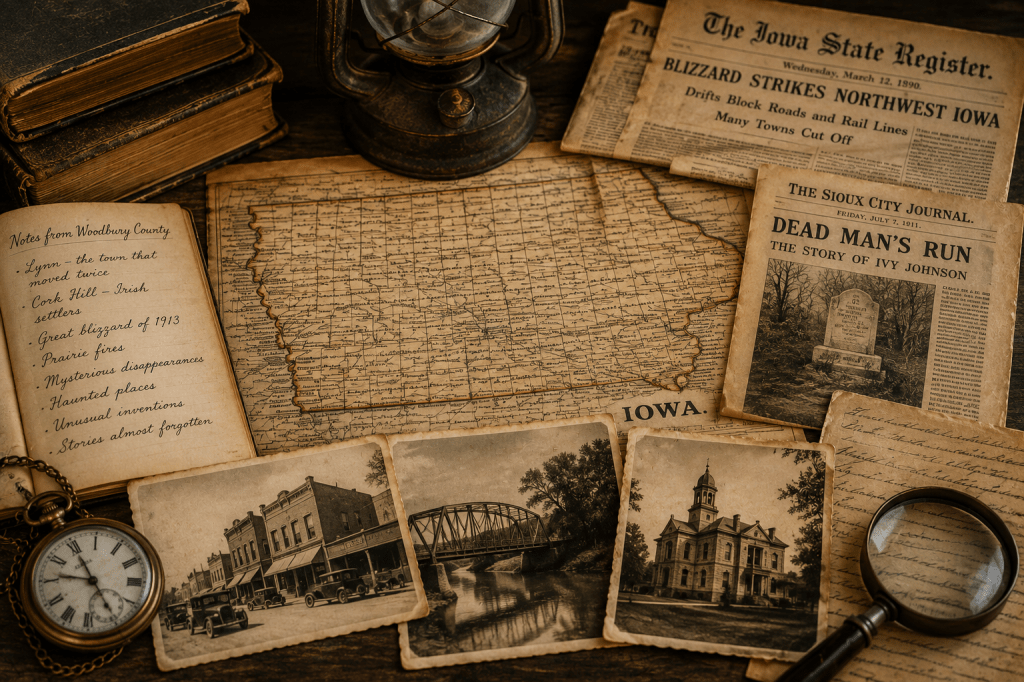
When most people think about Iowa history, they probably picture pioneers, farms, small towns, old courthouses, and perhaps a one-room schoolhouse or two.
And all of those things belong in our history.
But start digging through old newspapers, county histories, archives, and forgotten local stories, and you discover another Iowa entirely.
An Iowa where a man hiccupped for nearly seven decades.
Where towns appeared, flourished for a little while, and disappeared.
Where fires, blizzards, crimes, strange coincidences, unusual inventions, local legends, and unforgettable characters filled newspaper columns.
Some of the stories sound almost impossible.
And yet, they happened here.
History Is Often Hiding in Plain Sight
One of the things I love most about local history is realizing how easy it is to drive past a place without knowing what happened there.
A quiet road may once have led to a town that no longer exists.
An ordinary-looking building may have survived a disaster.
A creek, hill, or country road may carry a name whose meaning has been forgotten.
And the person whose name appears on an old gravestone may have once been the subject of a story that everyone in town knew.
Time has a way of turning remarkable events into ordinary scenery.
That is one reason old newspapers are so fascinating. They remind us that the people who lived in our towns generations ago weren’t simply names and dates.
They had arguments.
They survived terrible weather.
They started businesses.
They invented things.
They committed crimes.
They fell in love.
They made mistakes.
And occasionally, they did something so unusual that people were still talking about it decades later.
The Iowa Farmer Who Hiccupped for 68 Years
One of my favorite examples comes from very close to home.
Charles Osborne of Anthon, Iowa, began hiccupping in 1922 after an accident while preparing a hog for slaughter.
And he kept hiccupping.
For 68 years.
His extraordinary condition eventually made him famous far beyond Iowa. Doctors studied him, strangers mailed him suggested cures, and he appeared on national television.
Yet behind the record was an ordinary Iowa man who continued living his life while dealing with something most of us can barely imagine enduring for an afternoon.
Stories like Osborne’s are exactly what fascinate me about history.
Sometimes the most extraordinary story in America happened in a town most Americans have never heard of.
Even the Names on the Map Have Stories
Then there are the places that disappeared altogether.
Iowa is dotted with the remains and memories of former settlements—places that once had post offices, stores, churches, schools, homes, and people who considered them their hometown.
Woodbury County alone has had communities that vanished as railroads changed routes, businesses moved, and populations shifted.
Today, sometimes all that remains is a cemetery, an old road, a name in a county history, or a few lines in a newspaper.
But for the people who lived there, these weren’t “ghost towns.”
They were home.
That distinction matters.
Sometimes the Legend Isn’t the Real Story
Local history also has a wonderful habit of changing as it is passed from one generation to another.
A particularly good example is Dead Man’s Run in Woodbury County.
An old version of the story claimed that early settler Ivy Johnson had been pursued, killed, and scalped while hunting.
The historical record tells a different—and still tragic—story.
Johnson was working with a government surveying party in the early 1850s. During the survey, a gun discharged and Johnson was killed. He was buried nearby, and a marble marker was later brought from Council Bluffs to mark his grave.
The place became known as Dead Man’s Run.
The legend may have grown more dramatic over the years, but to me the documented story is every bit as interesting.
That is part of the fun—and responsibility—of researching local history: finding out where the story ends and the legend begins.
Why These Little Stories Matter
It would be easy to dismiss stories like these as trivia.
I don’t think they are.
The grand events of history tell us what happened to states and nations.
Little stories tell us what it was like to live there.
They tell us what people feared, laughed about, argued over, survived, celebrated, and remembered.
And sometimes they preserve people who otherwise would have disappeared completely from the historical record.
That is why I started collecting these stories.
The more I looked, the more I realized Iowa wasn’t short on strange history.
We had simply forgotten much of it.
The Stories Became a Book
That search eventually became my book, Only in Iowa: Strange But True Tales from the Hawkeye State.
The book travels through local legends, crime and dark history, strange places and landmarks, inventions and firsts, famous Iowans, ghost towns, unusual town names, weather records, haunted places, and plenty of other pieces of Iowa history that made me stop and say:
Wait. That really happened here?
Some stories are funny.
Some are unsettling.
Some are heartbreaking.
And some are simply wonderfully strange.
But the purpose isn’t to sensationalize Iowa’s past.
It’s to remember it.
Because Iowa has never needed to shout about itself.
You just have to know where to look.
Iowa keeps its stories until you’re ready to find them.


Leave a Reply