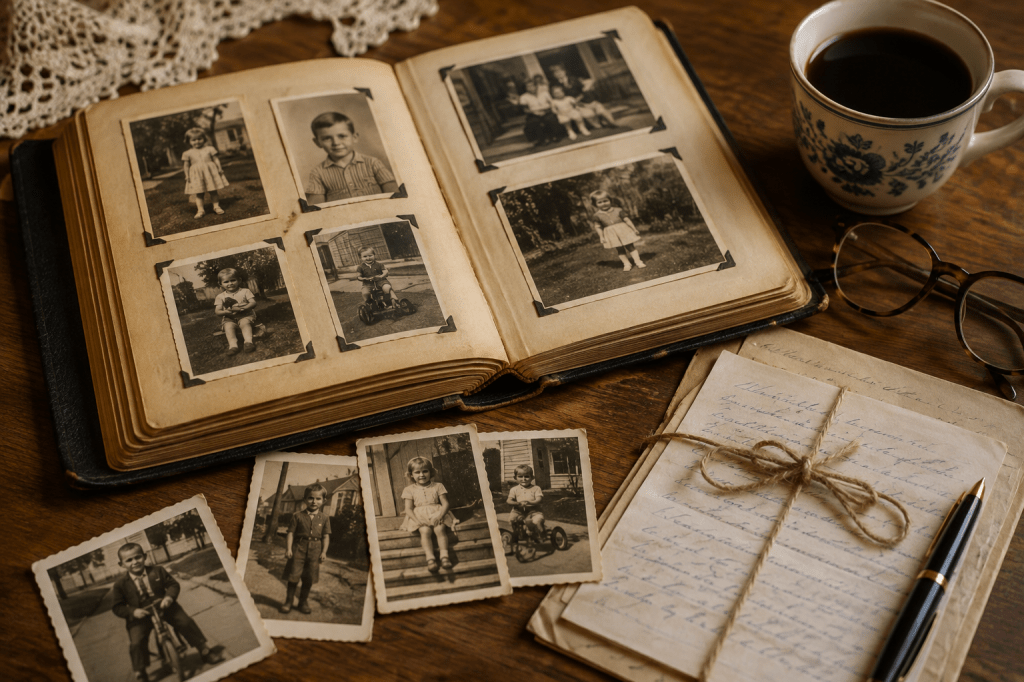
We think we know our parents.
We know the stories they tell every Christmas. We know where they grew up, what they did for a living, and maybe even how they met.
But do you know what your mother did when she got in trouble as a child?
Do you know what your father’s bedroom looked like?
Who was his best friend?
What your mother bought with her first bit of spending money?
What supper smelled like when they walked into the kitchen after school?
Those are the little details that disappear.
And often, they’re the details we wish we’d asked about most.
Don’t Just Ask for Dates—Ask for Memories
Genealogy is very good at preserving facts.
Birth dates. Marriage dates. Addresses. Names of parents and grandparents.
But a family tree can’t tell you that Grandpa hated peas, that Grandma walked three blocks to school with her best friend every morning, or that the family crowded around one radio in the living room on Saturday nights.
For those things, we have to ask.
The good news is that you don’t need a formal interview or a complicated list of genealogy questions.
You just need to start a conversation.
25 Questions to Ask Your Parents About Their Childhood
Try a few of these the next time you’re together:
- What is the earliest memory you can remember?
- What was the house you grew up in like?
- Did you share a bedroom with anyone?
- What was your neighborhood like?
- Who was your best friend when you were little?
- What games did you play outside?
- What toys did you love most?
- What did you usually do after school?
- What was your favorite meal your mother or father made?
- Was there a food you absolutely hated?
- What chores did you have?
- Did you receive an allowance? What did you spend it on?
- What happened when you got in trouble?
- Were your parents strict?
- What was school like?
- Who was your favorite teacher?
- How did you get to school?
- What did your family do on Sundays?
- Where did your family shop for groceries and clothes?
- Did your family take vacations? Where did you go?
- What holidays were the biggest celebrations in your house?
- What did you want to be when you grew up?
- What frightened you when you were a child?
- What is something children today would find surprising about your childhood?
- If you could go back and experience one day from your childhood again, which day would you choose?
The Best Question May Be the One You Didn’t Plan to Ask
Here’s something important:
Don’t worry about getting through the list.
If you ask your mother what she did after school and she suddenly starts telling you about the little grocery store on the corner, stay with the grocery store.
Ask what it looked like.
Who owned it?
What did a candy bar cost?
Did the owner know all the children by name?
What did she buy there?
One memory often unlocks another.
That’s where the best stories are hiding.
Ask About Ordinary Things
People tend to think their ordinary memories aren’t important enough to preserve.
They are.
In fact, those may become some of the most precious memories to future generations.
Ask about the kitchen table.
The family car.
Saturday mornings.
Bath night.
The walk to school.
Grandma’s apron.
The sound of Grandpa coming home from work.
The corner store.
The family dog.
These details may have seemed completely unremarkable at the time.
Fifty or one hundred years later, they’re a window into another world.
Record More Than the Answer
If your parent is comfortable with it, use your phone to record the conversation.
You don’t need professional equipment. A simple voice recording can preserve something written notes never will:
their voice.
Their laugh.
The pause before a memory comes back.
The way they pronounce an old neighbor’s name.
The little chuckle when they remember something they probably weren’t supposed to do.
Someday, those sounds may matter every bit as much as the story itself.
If recording feels awkward, simply take notes afterward. Even a few sentences are better than allowing the memory to disappear.
Don’t Wait for the Perfect Time
It’s easy to think you’ll do this someday.
At the next holiday.
When everyone has more time.
When you finally organize the family photographs.
When you start working seriously on the family tree.
But preserving family stories doesn’t require a special occasion.
Ask one question over coffee.
Ask another while you’re driving somewhere together.
Pull out an old photograph and ask, “What do you remember about this?”
That’s enough to begin.
Because family history isn’t only about discovering the people who came before us.
Sometimes it’s about noticing that part of our family history is sitting right across the table.


Leave a Reply