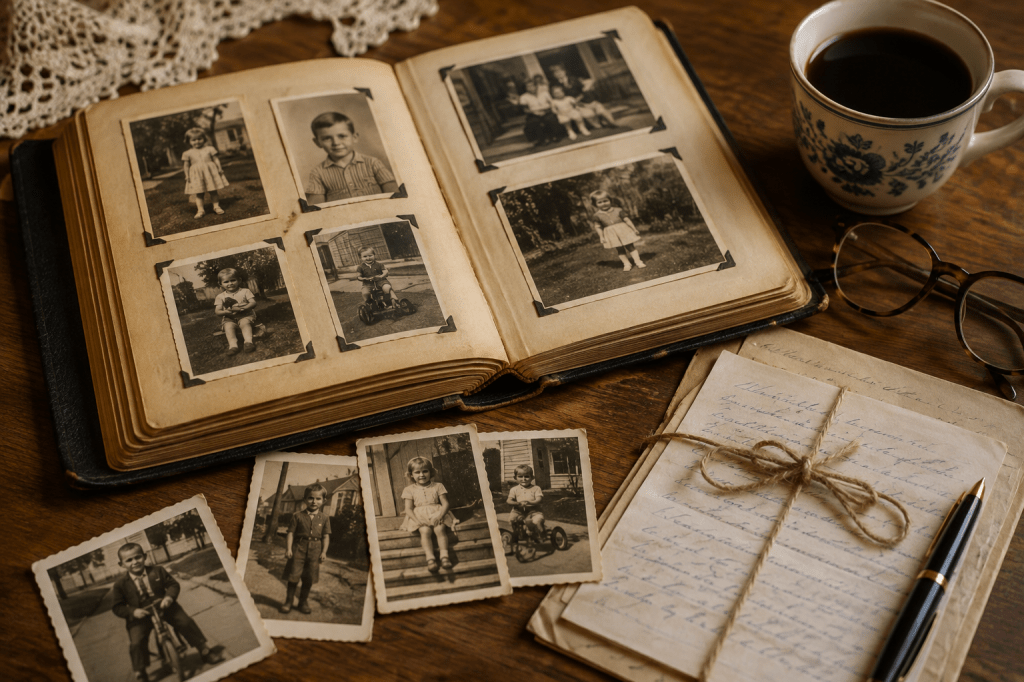
You know you should write down your family stories.
You’ve probably thought about it more than once.
Maybe you have boxes of photographs you mean to identify. Maybe your mother tells wonderful stories about growing up that you’ve never recorded. Maybe you know pieces of your grandparents’ lives but aren’t quite sure how all those pieces fit together.
So you tell yourself:
Someday, I’m going to get all of this organized.
The trouble is that “someday” can turn into years.
Family history can feel like an enormous project when you imagine starting at the beginning and documenting everything.
But you don’t have to start at the beginning.
You just have to start with one story.
Forget About Writing the Whole Family History
One of the easiest ways to never begin is to decide you’re going to write your family’s entire history.
Suddenly you need birth certificates, marriage records, census records, photographs, family trees, newspaper clippings, military records and a filing system.
That’s enough to make anyone close the box and put it back in the closet.
Instead, make the project smaller.
Don’t write the family history today.
Write about the time Grandpa bought his first car.
Write down Grandma’s Christmas candy recipe and why she made it every year.
Record the story about the cow that got loose on your father’s first day of school.
Describe the house where you grew up.
One memory is enough.
Start With the Story You Already Know
You don’t need to begin with your oldest known ancestor.
Start with something you can remember right now.
Think about a story your family tells over and over.
Maybe it’s funny. Maybe it’s sad. Maybe it’s something that happened at Christmas, on a vacation, during a storm or around the supper table.
Write down everything you remember.
Then ask yourself:
Who was there?
Where did it happen?
About what year was it?
What happened before and afterward?
Why does our family still tell this story?
Those few questions can turn a two-sentence memory into something a future grandchild can actually picture.
Use Photographs as Memory Starters
If staring at a blank page doesn’t inspire you, open an old photo album instead.
Choose one photograph.
Don’t worry about identifying every person in the album. Just look at that one picture.
Who is in it?
Where was it taken?
What was happening that day?
What do you remember about the house, car, clothing or people in the photograph?
Is there something outside the frame that only you know?
A photograph might show four children standing in front of a farmhouse.
But perhaps you know that the dog had just run through the picture before the shutter clicked, everyone had been arguing about who had to stand next to whom, and Grandma made them change into their good clothes before the photograph was taken.
That’s the story.
The photograph preserves what things looked like.
Your memories preserve what it felt like to be there.
Record a Conversation Instead of Writing
Not everyone enjoys writing, and that’s perfectly fine.
Family stories don’t have to begin on paper.
Sit down with a parent, grandparent, aunt, uncle or sibling and turn on the voice recorder on your phone—with their permission.
Then ask one question.
What was your childhood home like?
What did you do for fun?
What was Grandma like when you were young?
What do you remember about Christmas when you were a child?
Don’t worry about conducting a perfect interview.
Have a conversation.
You can always transcribe the important parts later.
And you’ll have something else that’s impossible to capture on paper: a person’s voice and laughter.
Don’t Ignore Your Own Stories
When people become interested in family history, they often look backward.
We want to know about great-grandparents and immigrants and ancestors whose names appear on old documents.
But there’s someone else whose story belongs in the family history.
Yours.
Your childhood bedroom may seem ordinary to you.
Your first job may not feel historically important.
The car your parents drove, the television shows you watched, the games you played, the stores where your family shopped and the meals you ate every week may seem too everyday to record.
They aren’t.
Imagine how much you would treasure a few pages written by your great-grandmother describing an ordinary Tuesday when she was twelve.
Someday, someone may feel exactly the same way about your memories.
Give Yourself a Ten-Minute Rule
If you’ve been putting this project off because you don’t have enough time, give yourself ten minutes.
Set a timer.
Choose one memory.
Write until the timer rings.
Then stop.
You do not need to finish anything.
Ten minutes this week and ten minutes next week will preserve more family history than waiting five years for the perfect free weekend.
Keep a Running Story List
Once you begin, memories tend to lead to other memories.
Keep a notebook or a note on your phone called Family Stories.
Whenever something pops into your head, add it.
Dad’s first car.
Grandma’s garden.
The tornado story.
Christmas at Aunt Mary’s.
The old farmhouse.
The summer we went to Yellowstone.
Grandpa’s favorite saying.
Mom’s first job.
Don’t try to write the story right then.
Just capture the idea.
The next time you have ten minutes, choose one.
It Doesn’t Have to Be Perfect
This may be the most important part.
You aren’t writing a history textbook.
You don’t have to be a professional writer.
Your spelling doesn’t have to be perfect. Your memories don’t have to arrive in chronological order. You don’t need beautiful handwriting or expensive genealogy software.
You are preserving something only you can preserve:
what you remember.
Dates and records can often be found later.
Memories can’t always be recovered once the person who carried them is gone.
So don’t wait until you’re organized.
Don’t wait until you’ve finished the family tree.
Don’t wait until you know exactly how you’re going to preserve everything.
Pick one photograph.
Ask one question.
Write one memory.
One story is enough to begin.


Leave a Reply