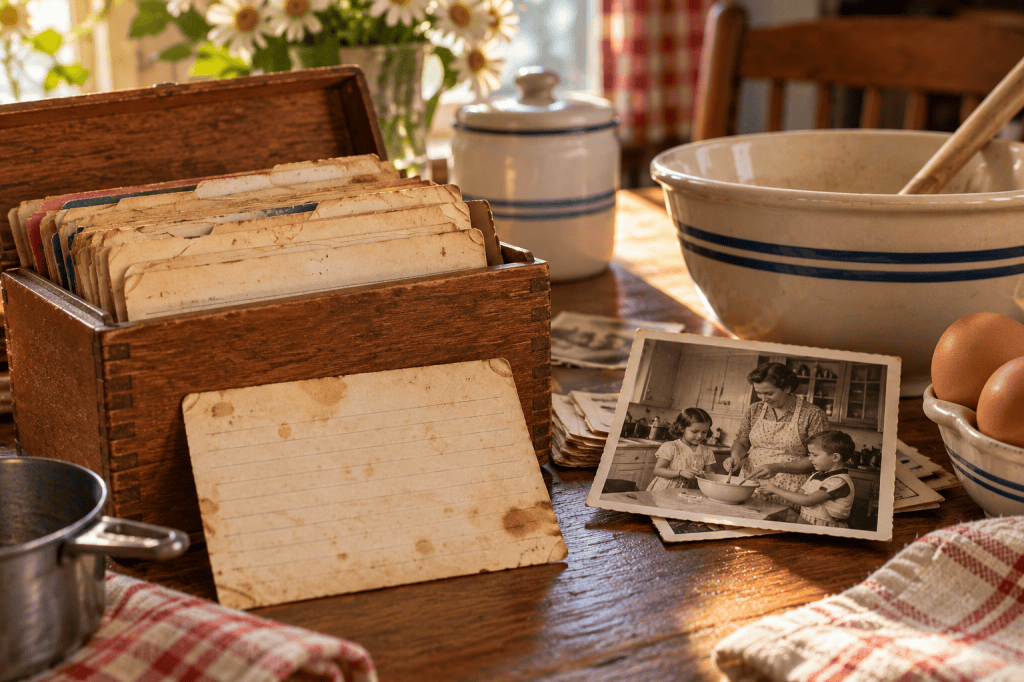
Some of the most valuable pieces of family history aren’t stored in archives.
They’re tucked inside recipe boxes.
They may be written on stained index cards, clipped from old newspapers, scribbled on the back of an envelope, or copied carefully into a little notebook that once sat in someone’s kitchen.
Grandma’s sugar cookies.
Mom’s potato salad.
Aunt Mary’s Christmas candy.
The casserole that appeared at every church supper.
At first glance, they’re simply recipes.
But look a little closer, and you may be holding a piece of your family’s story.
A Recipe Card Can Tell You More Than How to Make Supper
Old handwritten recipes have a personality that typed recipes simply don’t.
Maybe Grandma never wrote down an oven temperature because she knew exactly how hot the oven should be.
Maybe the instructions say:
“Bake until done.”
Or:
“Add enough flour.”
Helpful, Grandma.
But those little quirks tell us something.
They remind us that the person who wrote the recipe had probably made it so many times that measuring and timing were almost instinctive.
Then there is the handwriting itself.
A familiar slant.
A word crossed out.
A little note squeezed into the margin.
A grease spot or flour stain.
Those aren’t imperfections.
They’re evidence that someone actually stood in a kitchen and used that card.
Ask Where the Recipe Came From
If you’re fortunate enough to have someone who remembers the recipe, don’t stop at asking how to make it.
Ask about its story.
Who originally made this?
Was it served for holidays or everyday meals?
Did everyone in the family like it?
Was there someone who always asked for seconds?
Did the recipe come from a relative, neighbor, church cookbook, or newspaper?
Did anyone change the recipe over the years?
Suddenly you’ve preserved much more than a list of ingredients.
You’ve preserved a memory.
Food Can Bring Back Memories We Thought We’d Forgotten
Sometimes all it takes is the smell of one familiar food.
Cinnamon rolls baking.
Coffee perking.
Bread fresh from the oven.
Tomatoes cooking on the stove.
A particular Christmas candy.
And suddenly you’re back in a kitchen you haven’t seen in forty years.
You remember the table.
The curtains.
The dishes.
The sound of people talking in the next room.
Maybe you remember sitting on the counter while your mother baked or watching your grandmother roll pie dough across a flour-covered table.
Food has an extraordinary ability to carry memories with it.
That’s why family recipes deserve a place in our family histories.
Don’t Forget the Everyday Foods
We tend to preserve recipes for special occasions.
Christmas cookies. Wedding mints. Birthday cakes. Thanksgiving stuffing.
But ordinary meals tell stories too.
What did your family eat on busy weeknights?
What did your mother make when money was tight?
Did your father have a favorite supper?
What was always packed in school lunches?
What did you eat during harvest?
Was there a particular meal your family had every Sunday?
Those everyday details tell future generations something about how your family actually lived.
Preserve the Original Before It’s Lost
Old recipe cards aren’t indestructible.
Ink fades.
Paper becomes brittle.
Cards disappear when households are cleaned out.
If you have handwritten family recipes, photograph or scan them.
And don’t throw the originals away just because you’ve made digital copies.
The handwriting matters.
If possible, record who wrote each recipe and approximately when it was used.
Even something as simple as:
“Written by Margaret McKenna, probably in the 1950s. She made these every Christmas.”
can turn an unidentified recipe card into a family heirloom.
Make the Recipe—and Write Down What Happens
One of the nicest ways to preserve a family recipe is simply to make it again.
Invite your children or grandchildren into the kitchen.
Tell them who used to make it.
Tell them what you remember.
Laugh about the instructions that don’t make any sense.
And if the recipe needs adjusting because Grandma’s idea of “a handful” isn’t quite precise enough for the rest of us, write down what you discover.
You’re not changing the family history.
You’re helping it continue.
Create a Family Recipe Story Collection
You don’t need to make an elaborate cookbook.
Start with five recipes.
For each one, include:
- A copy or photograph of the original recipe
- The typed recipe so it’s easy to read
- The name of the person associated with it
- A photograph of that person, if you have one
- A short paragraph about when the food was served and what you remember about it
Imagine receiving something like that from your great-grandmother.
That’s how valuable the little project you’re creating may someday become.
The Recipe Isn’t Really the Treasure
Someday, someone in your family may make that cake without ever having met the woman who first baked it.
They may recognize her handwriting but never have heard her voice.
They may know her only through photographs and stories.
But for a little while, they’ll stand in their kitchen measuring the same ingredients and following the same instructions she once followed.
That’s the wonderful thing about family recipes.
They don’t simply tell us what our families ate.
They tell us who gathered around the table.
And sometimes, tucked between the flour stains and faded handwriting, they help us find our way back there.
 Nora Bramwell
Leave a comment