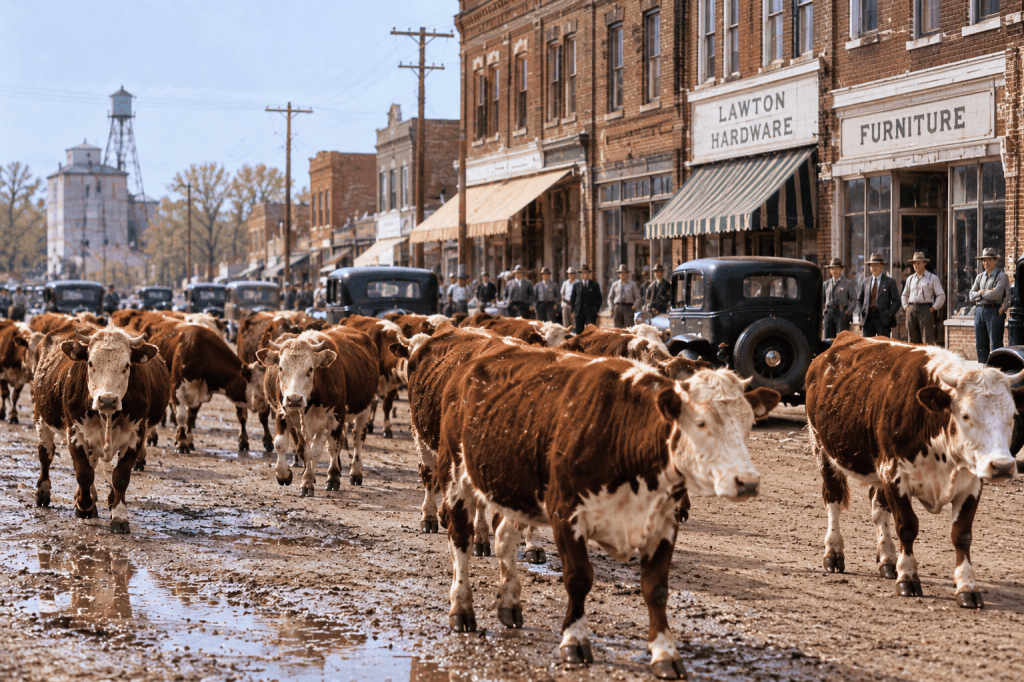
Imagine looking out your window in Lawton, Iowa, and seeing cattle, hogs, and sheep wandering through town.
Across lawns.
Through shrubbery.
Past the post office.
It sounds like the beginning of a comedy.
But according to a historical account of the 1932 Farmers’ Holiday movement, something remarkably close to that really happened.
And the story behind it wasn’t funny at all.
Iowa Farmers Were Desperate
By the summer of 1932, the Great Depression had placed Iowa farmers in an increasingly desperate position.
Crop and livestock prices had collapsed.
A Woodbury County history prepared by the Iowa Writers’ Program later recorded corn selling for about 22 cents a bushel, oats for 11 cents, hogs at $3.85 per hundred pounds, and milk bringing roughly $1 per hundredweight.
For many farm families, those prices simply weren’t enough to cover taxes, mortgages, and the cost of producing what they were selling.
The Farmers’ Holiday Association proposed a radical response.
Farmers would take a “holiday.”
Not the relaxing kind.
They would stop sending farm products to market in hopes that withholding food and livestock would force prices upward.
Northwest Iowa became one of the centers of the movement, and Sioux City became the scene of some of its most dramatic confrontations.
Milk Ran Into the Ditches
On August 11, 1932, hundreds of pickets confronted milk trucks several miles east of Sioux City.
Drivers were told to turn back or lose their loads.
Milk was dumped.
The Iowa Writers’ Program account estimated that more than 1,000 gallons flowed across the highway and into the drainage ditches.
But there was a fascinating contradiction.
While milk was being destroyed outside the city, free milk stations were operating inside Sioux City.
Residents reportedly arrived carrying buckets, pans, and kettles to receive milk without charge.
The farmers were trying to make a point: their fight was over the price they were being paid—not with families who needed food.
Then, a few months later, things became even stranger.
The Livestock Train Near Lawton
According to the 1942 Iowa Writers’ Program history of Woodbury County, pickets pursued a livestock train in early November and managed to get ahead of it near Lawton.
Railroad ties were placed across the tracks.
The engineer stopped.
Then the livestock cars were opened.
Out came Hereford cattle, hogs, and sheep.
The animals scattered.
The historical account describes livestock wandering through fields and through Lawton itself—across lawns and shrubbery and even past the post office.
Some reportedly wandered miles away from the railroad tracks during the night.
Just imagine waking up the next morning and discovering that your shrubbery had become breakfast for a cow that had arrived by train.
A Strange Story With a Serious History
The image of livestock roaming Lawton is wonderfully strange.
But the reason it happened shouldn’t be forgotten.
These were Depression-era farmers watching the value of everything they produced collapse while mortgages, taxes, and other expenses remained.
The Farmers’ Holiday movement didn’t permanently solve the agricultural crisis, and some of its confrontations became violent and controversial.
But for a time, northwest Iowa became part of a national struggle over the survival of American farms.
And one extraordinary chapter of that struggle played out near a small Woodbury County town.
Today, you can drive through Lawton without any indication that cattle, hogs, and sheep once reportedly wandered through town as part of one of the most unusual farm protests in Iowa history.
That’s one of the things I love about local history.
Sometimes an ordinary-looking place has an extraordinary story hiding underneath it.
This is one of the stories featured in Woodbury County, Iowa: Strange But True, a collection of unusual, forgotten, and remarkable stories from Woodbury County’s past.


Leave a comment