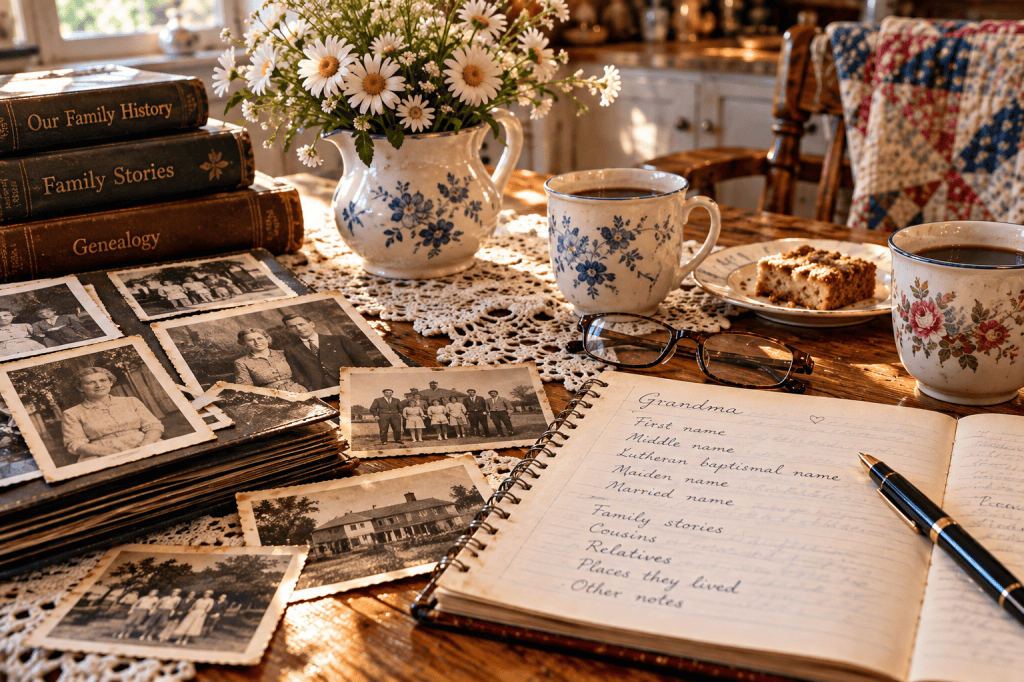
When we think about family history, we often think about names, dates, marriages, and places on a family tree.
But some of the most interesting family stories have nothing to do with any of those things.
They’re the little details.
What did Grandma keep in her kitchen cupboard? What did Grandpa do on Saturday nights? What did their house smell like when they were growing up?
Those are the things we rarely think to ask.
And sometimes, by the time we realize how much we’d love to know, the person who could answer is no longer here.
The Everyday Things That Tell the Best Stories
Most of us know where our grandparents were born, when they married, and perhaps where they worked.
But do we know what an ordinary Tuesday looked like when they were young?
Did they walk to school? Did they have chores before breakfast? Was there a special treat their mother made when money was tight?
It’s easy to overlook everyday life because it doesn’t seem particularly important while we’re living it.
But fifty or a hundred years later, those ordinary details become fascinating pieces of history.
The Questions We Don’t Think to Ask
Here are a few questions that might uncover stories you’ve never heard before:
- What did your childhood home look like inside?
- What was your favorite meal your mother made?
- Did your family have a radio, and what did you listen to?
- What did you do for fun when you were a teenager?
- What was the first thing you bought with money you earned?
- Did you have a favorite teacher?
- What did your family do on Sunday afternoons?
- What was Christmas morning like when you were little?
- Did you ever get into trouble and keep it a secret?
- What is something about your parents that you wish more people knew?
That last question might be my favorite.
Sometimes the answer reveals an entirely different side of someone we thought we knew.
Ask About the Things in the House
Family heirlooms don’t have to be valuable antiques.
An old mixing bowl, a worn recipe book, a pocketknife, or a faded photograph might hold more family history than an expensive piece of furniture.
Ask why someone kept a particular object.
Who gave it to them? How old is it? Was it used every day?
Even the most ordinary possessions can have extraordinary stories attached to them.
And without those stories, future generations may never understand why those things mattered.
Don’t Forget to Ask About Feelings
We tend to ask what happened.
But sometimes we forget to ask how it felt.
What was it like leaving home for the first time?
Were they nervous on their wedding day?
What was their proudest moment?
Was there a time when they were especially frightened, excited, or happy?
Those answers help us understand our grandparents as people, not simply as names on a family tree.
Sometimes the Best Stories Come From Unexpected Questions
You don’t need a formal interview or a long list of questions.
Sometimes all it takes is sitting at the kitchen table and asking, “What was your house like when you were little?”
One answer leads to another.
Suddenly you’re hearing about the old cookstove, the neighbor who always stopped by, or the winter when the snow was so deep nobody could get to town.
Those are the stories worth saving.
If possible, record the conversation—with permission—or write down what you remember afterward.
And don’t worry if the conversation wanders away from your original question.
That’s often where the best memories are hiding.
The Lessons I Learned at Grandma’s Kitchen Table
Some of my favorite memories are of sitting at my grandmother’s kitchen table, talking about family.
She was the one who taught me how to figure out all those family relationships. First cousins, second cousins, first cousins once removed—she would explain how everyone was related, and we’d have so much fun figuring it all out.
I can still picture us sitting there, just like it was yesterday.
Another memory that makes me smile is how tickled she was when I took the time to learn her entire name.
And I do mean her entire name!
There was her first name, middle name, Lutheran baptismal name, maiden name, and finally her married name. Quite a mouthful! She explained to me that they were given their baptismal names at birth, and she knew and used hers.
I remember how much fun we had going through all of it.
The funny thing is, at the time, I had no idea how much those little afternoons at her kitchen table would mean to me someday.
We weren’t having formal genealogy lessons. We were just talking, laughing, and figuring out who belonged where on the family tree.
Years later, when I became interested in genealogy, I realized how much she had taught me without either of us even knowing it.
Those little conversations came in awfully handy.
But even more than that, they became some of my most treasured memories.
I wish I could sit at that kitchen table with her just one more time.
There are so many things I’d love to ask her now.
And isn’t that exactly why we need to ask these questions while we still can?
The Stories We Wish We’d Asked About
I think almost everyone who has lost a parent or grandparent has experienced that moment.
You find an old photograph, a handwritten recipe, or a familiar object, and suddenly you have a question.
A question you never thought to ask.
That’s why preserving family stories matters so much.
Not because every memory is historically important.
But because every family has stories that deserve to be remembered.
And sometimes the smallest details are the ones we miss the most.
The next time you visit an older relative, ask one question you’ve never asked before.
You might be surprised by the story you bring home.


Leave a Reply